
Reviewed · OSAKA PRIVATE TOURS
Nara: Half-Day Private Tour of 4 Must-See Spots & Deer Park
Nara’s appeal comes into focus on foot: a towering Buddha, ancient temple grounds, lantern-lined Kasuga Taisha and deer wandering through the park all sit within one cultural day out. This private tour links those sights with a local guide, so you get stories along with the photographs.
I like the mix of major landmarks and everyday history, especially the contrast between Todai-ji’s scale and Naramachi’s old merchant houses. I also like that the guide provides deer crackers, and that admission to Todai-ji and Kofuku-ji is included.
The main consideration is the amount of walking. The tour lasts 5 to 7 hours, lunch and transport are not included, and it is not suitable for wheelchair users or people with mobility impairments. Check your meeting point carefully, too, since the available options include locations in Kyoto and Osaka as well as Nara.
What makes this Nara tour worth considering
- The Great Buddha is the centerpiece: Allow about two hours for Todai-ji and its temple grounds, with a guide to explain the site’s Buddhist context.
- The deer encounter comes with a little guidance: Deer crackers are included, and your guide can help you follow safe, respectful practices around the wild animals.
- You see more than temples: The route also includes Nara Park, Kasuga Taisha and Naramachi’s traditional buildings.
- It is private, not a shared group walk: You travel as a private group with an English- or Japanese-speaking guide.
- The $120 price covers some important costs: Admissions to Todai-ji and Kofuku-ji, plus deer crackers, are included. Lunch and transportation are not.
A walking route through Nara’s old center
The tour is described as half-day, but its stated duration is 5 to 7 hours. That is a substantial outing, not a quick stop between trains. The listed guided visits alone account for several hours, before you add the walks between sites, photographs, deer time and lunch.
The route begins at one of several possible meeting points. These include the Gyoki Bosatsu statue, a Lawson convenience store in Namba, and Kintetsu Kyoto Station. Those are not interchangeable places, so check the exact option you select and plan your own journey to the meeting point. Transportation to and from the attractions is not included.
From the start, the tour moves through a historic shopping arcade toward Kofuku-ji and then on to Nara Park and Todai-ji. Later stops include Kasuga Taisha and Naramachi. The schedule gives each place time for a guided visit, though the order of lunch and Kasuga Taisha is not presented consistently in the tour details. If the sequence matters to you, confirm it before you go.
The private format is useful here. You can ask questions as you walk, and the guide can connect the temples, shrine and old town rather than treating them as isolated photo stops. It is a guided walking tour, though, not a chauffeured circuit. Wear shoes you can comfortably walk in, bring water, and be ready for weather that may call for a hat and sunscreen.
More private tours around Nara:
- Nara Half Day Trip Walking Tour (Private Option Available)
★ 5.0 · 937 reviews - Nara 6hr Private Tour with Government-Licensed Guide
★ 5.0 · 219 reviews - Nara: Private Tour with Private Guide
★ 4.8 · 66 reviews
Kofuku-ji and the first temple stop
Kofuku-ji is the first named temple visit, with about 25 minutes set aside for the guided stop. Its five-story pagoda is the headline sight and a natural place to pause for photographs. The temple also gives the guide an early chance to introduce Nara’s Buddhist heritage before you reach Todai-ji’s much larger complex.
Admission to Kofuku-ji is included, which is a helpful part of the value. Still, 25 minutes is a short visit. Think of this as an introduction and a chance to see the pagoda, not an unhurried exploration of every part of the grounds. If you want extra time at the temple, ask whether the schedule allows it.
The route passes through a shopping arcade, then continues toward Nara Park. That shift from town streets to open grounds is part of the appeal: Nara’s major religious landmarks are woven into an everyday city, rather than set apart as a single museum-like site.
Nara Park and its deer
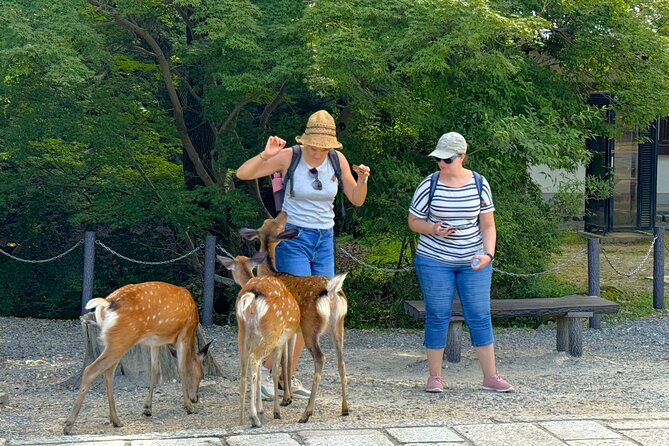
Nara Park’s deer are more than a cute interruption to the temple route. They are wild animals, and local tradition regards them as divine messengers. The tour connects that belief to a history stretching back more than 1,200 years, giving the encounter a cultural context you might miss if you simply stop for a quick photograph.
Deer crackers are included, so you do not need to purchase them as part of this experience. Feeding wildlife is still a moment to pay attention: follow your guide’s instructions and treat the deer with respect. The tour specifically asks you to be prepared for safe interaction, a sensible reminder in a park where deer may approach once food is visible.
The stop is also a photo opportunity, but it is worth keeping your camera ready without letting it take over. Flash photography is not allowed on the tour, and the deer are best approached with care rather than treated as props. If you are nervous around animals, tell your guide and follow their directions.
Todai-ji and the Great Buddha
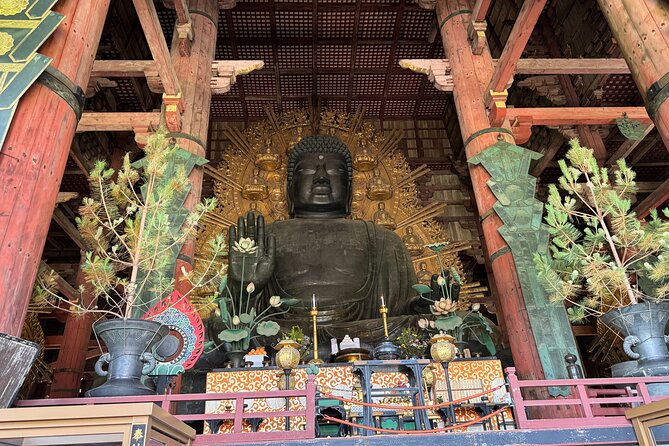
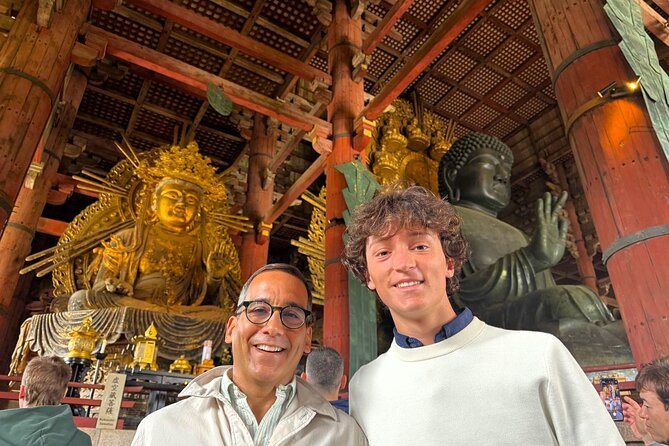
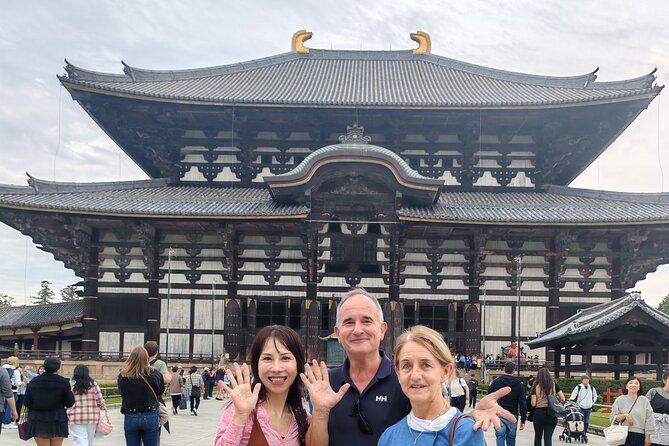
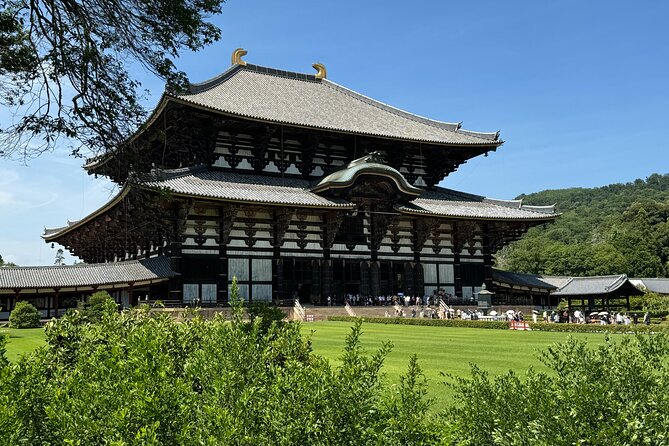
Todai-ji is the longest stop, with about two hours scheduled for a guided visit. Its Great Buddha is the tour’s central sight: a vast statue that gives scale to the temple’s role in Japanese Buddhism. On the approach, two imposing guardian figures known as Kongo Rikishi mark the way, adding another memorable stop before you enter the main temple area.
Admission to Todai-ji is included, which matters at a site where you will spend a good portion of the day. The guide’s explanations are part of the value, too. Instead of seeing the Buddha as a large sculpture alone, you can hear about Japanese Buddhism and the significance of the temple.
The route also includes Nigetsu-do, where you can enjoy a view over Nara. It offers a different perspective from the close-up temple visit and gives you a reason to look beyond the Great Buddha. Keep in mind that this is still a walking tour, and the route includes movement through temple grounds. Comfortable shoes are essential.
Two hours gives this major stop room to breathe, but the day is not only about Todai-ji. You still have Kasuga Taisha, lunch and Naramachi ahead, so it is worth pacing yourself and drinking water, especially in hot weather.
More half-day trips around Nara:
- Perfect Nara Park Half-Day Bus Tour with English Speaking Guide
★ 5.0 · 49 reviews - Nara: Half-Day Private Guided Tour
★ 4.6 · 6 reviews - Himeji Half-Day Private Tour with Government-Licensed Guide
★ 5.0 · 236 reviews - Half-day Himeji Castle Town Bike Tour with Lunch
★ 5.0 · 81 reviews
Kasuga Taisha and its lanterns
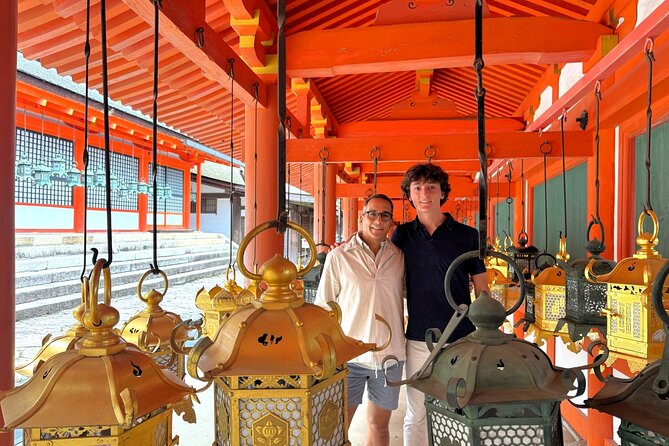
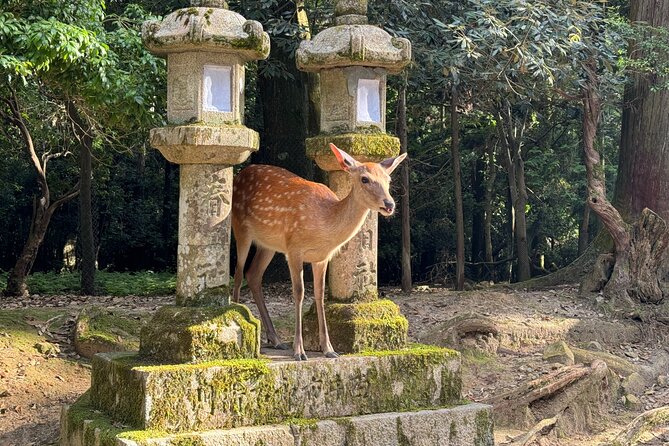
Kasuga Taisha is a shrine associated with Nara’s religious traditions and recognized as a UNESCO World Heritage Site. Its red buildings and hundreds of lanterns make it visually distinct from Todai-ji’s Buddhist temple setting. Seeing both on the same tour helps you compare two strands of Japanese religious life in one day.
The guided stop is listed at about 20 minutes. That is enough for an introduction and a look at the shrine, but it is not a long visit. The information provided includes admission to Todai-ji and Kofuku-ji, but does not list Kasuga Taisha admission as included. Check whether any entry fee applies to the parts of the shrine you plan to visit.
Wild deer gather in the park around the route to Kasuga Taisha, linking the shrine visit with the animal encounter. Keep your attention on the guide and the path as you move between stops. The combination of lanterns, shrine architecture and deer gives this part of the tour a different feel from the grand interior at Todai-ji.
Lunch and a look inside Naramachi
The tour includes a stop at a local restaurant for a traditional Japanese lunch, with about 45 minutes assigned to the lunch and guided portion in Nara. Food and drinks are not included in the price, so budget separately for your meal. The details do not name the restaurant or specify a menu, which means you should not count on a particular dish or dietary arrangement without checking ahead.
The schedule places lunch before the listed Kasuga Taisha visit, while the tour description lays out the shrine before the meal. The exact order may vary, or the details may simply differ. Ask the provider if you have a tight schedule or need to plan around a meal.
Naramachi brings the day down to a more human scale. Instead of temple grounds and monumental religious art, you walk among traditional buildings and visit a merchant’s house to see how people in the area lived. The guided stop is about 20 minutes, so expect a short window to look around rather than a long museum visit.
This contrast is one of the tour’s best ideas. Nara is often reduced to the Great Buddha and deer, but old town streets help you picture the people who lived and worked here. The experience is brief, but it rounds out a day otherwise weighted toward religious landmarks.
What the $120 price includes
At $120 per person, the tour’s value depends on how much you want a guide to connect the sights. Admission to Todai-ji and Kofuku-ji is included, as are deer crackers and the private local guide. For a day with several stops and a long visit to Todai-ji, those inclusions make the price easier to assess than a bare guiding fee.
The costs that remain outside the price are important. Lunch and drinks are extra, and transportation to and from the attractions is not included. That means you should think of $120 as the cost of the guided experience and specified admissions, not the full cost of your Nara day.
The private format may be especially useful if you want to ask questions, move at your group’s pace within the schedule, or have a guide help you understand the difference between a Buddhist temple and a Shinto shrine. If you prefer to explore at your own speed and do not need interpretation, you may find a self-guided visit more economical.
Who should book this walk
This tour suits you if you want a guided overview of Nara’s major sights and a few less obvious details, including the merchant’s house in Naramachi. It also makes sense if you value a private group and would rather have one guide explain the route than piece together the sites yourself.
It is less suitable if you have limited mobility, use a wheelchair, or want a low-walking day. The tour is explicitly not suitable for people with mobility impairments or wheelchair users. It may also feel rushed if you want to spend a long time at each temple, shrine or historic house, since several stops are short.
Bring comfortable shoes, water, a hat and sunscreen. Smoking and flash photography are not allowed. The tour is offered in English and Japanese, and free cancellation is available up to 24 hours in advance. You can reserve without paying immediately, but make sure the meeting location and transport plan fit your day.
Should you book it?
Book this tour if you want a full, guided introduction to Nara that balances the Great Buddha and temples with deer, lunch and an old merchant’s house. The strongest reasons are the private guide, included entry to Todai-ji and Kofuku-ji, and the chance to understand the sites in context.
Skip it if you want a short, easy outing, need step-free access, or prefer to set your own pace at every stop. Before booking, confirm your meeting point, how you will get to Nara, and whether you are comfortable paying separately for lunch and transport. Those practical details will shape the day as much as the temples do.
FAQ
How long does the tour last?
The tour lasts 5 to 7 hours. The exact duration depends on the selected starting time and tour schedule.
Which languages are available?
The live guide speaks English or Japanese.
Is this a private tour?
Yes. The activity is for a private group.
Are temple admissions included?
Admission to Todai-ji and Kofuku-ji is included. Kasuga Taisha admission is not listed among the included items.
Is lunch included in the price?
No. The tour includes a stop at a local restaurant, but food and drinks are not included.
Are deer crackers provided?
Yes. Deer crackers are included, along with interaction with Nara’s wild deer.
Where does the tour start and end?
The meeting point depends on the option booked. Listed starting options include the Gyoki Bosatsu statue, Lawson Namba 2-chome and Kintetsu Kyoto Station. Drop-off options include the Gyoki Bosatsu statue and Kintetsu Nara Station.
Is the tour suitable for wheelchair users?
No. The tour is not suitable for wheelchair users or people with mobility impairments.
Just added around Nara
- Nara: Write Your Own Name in Kanji (Japanese Calligraphy)★ 4.4 · 3 reviews
- Nara Heritage Walkabout from Nara Park to Todaji-ji temple★ 5.0 · 5 reviews
- Nara: Sake Tasting Tour at the Birthplace of Japanese Sake★ 4.9 · 8 reviews
- Nara: Private City Tour With A Local Guide★ 4.2 · 8 reviews
- Nara: Full-Day Private Guided Tour★ 5.0 · 4 reviews
- Nara: Cultural Heritage Tour by Rickshaw★ 5.0 · 5 reviews
- Nara: Cooking class, learning how to make authentic sushi★ 5.0 · 5 reviews
- Nara – Craft Beer, Sake, and Food Walking Tour★ 3.5 · 9 reviews
Osaka Private Tours, compared.
Nara Half Day Trip Walking Tour (Private Option Available)
Read our review →
Private Osaka Walking Tour: Highlights & Hidden Gems
Read our review →
Osaka 4hr Private Tour with Government-Licensed Guide
Read our review →
Himeji Half-Day Private Tour with Government-Licensed Guide
Read our review →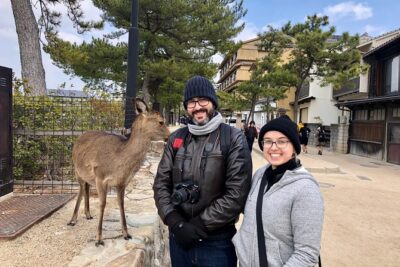
Nara 6hr Private Tour with Government-Licensed Guide
Read our review →
3/4/5 Hours Private Tour in Osaka with Local Guide
Read our review →
2.5 Hour Private History and Culture Tour in Himeji Castle
Read our review →
Osaka 6hr Private Walking Tour with Government Licensed Guide
Read our review →Browse the lists this tour appears in