Reviewed · OSAKA TOURS
【Family Friendly】Traditional Mochi Pounding Experience
Mochi pounding turns a familiar Japanese sweet into a lively group activity: you help transform steamed glutinous rice into a chewy treat, then eat what you made. At Oh Mochi in Dotonbori, the process is short, hands-on, and easy to fit between other Osaka plans.
I like two things in particular: you get to take part in the traditional pounding rather than simply watch, and the tasting lets you try the mochi with several classic toppings. The small group limit of 10 people also gives the activity a more personal feel than a large demonstration.
One consideration: this is a brief cultural activity, not a full cooking class. The session is listed at about an hour, though some families have finished in roughly 45 minutes, so plan on a compact experience rather than a long workshop.
Key points to know before you book
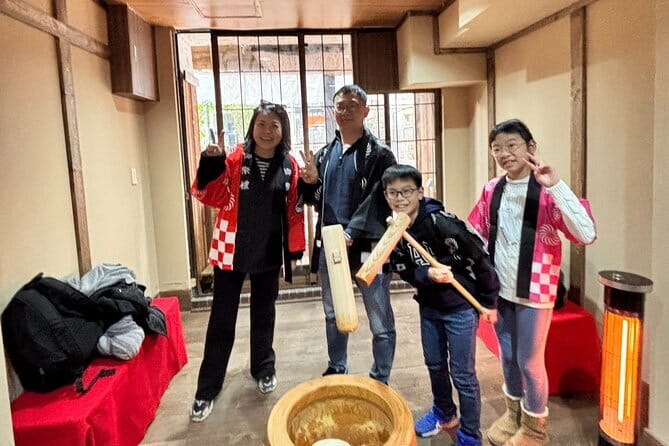
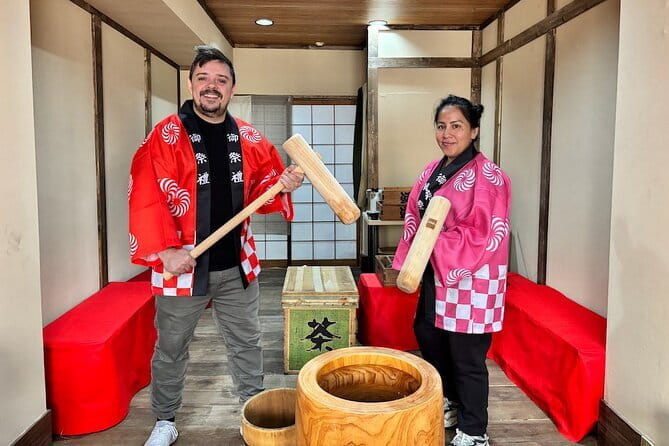
- You help pound the rice: Use a traditional mortar and pestle to work steamed glutinous rice into mochi.
- The tasting is part of the fun: Try fresh mochi plain or with kinako, sweet red bean paste, nori, and sweet soy sauce, served with tea.
- Children are welcome: The activity is open to children under 13, and adults can join without children.
- It fits a Dotonbori outing: The meeting point is in Dotonbori, and the activity ends back there.
- Expect a compact session: It is listed as approximately one hour, with some sessions reported to take around 45 minutes.
- The price is $32.29 per person: That covers a guided cultural activity and a tasting, not just a snack.
From steamed rice to a shared bowl of mochi
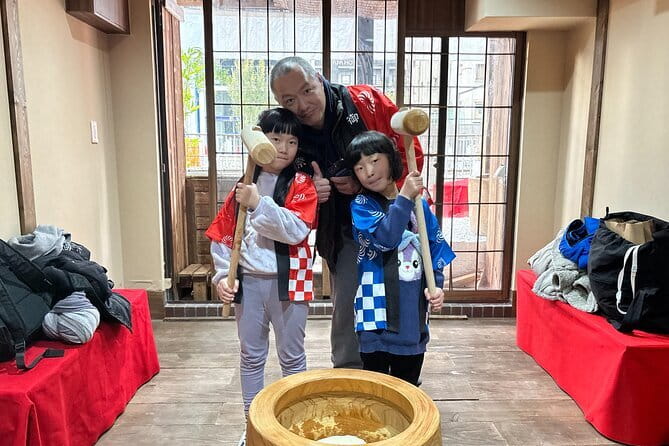
Mochi is made from glutinous rice, but the finished texture is quite different from an ordinary bowl of rice. The rice is steamed, then pounded until it forms a sticky, smooth mass that can be shaped and served. Here, you get to see and take part in that transformation instead of encountering mochi only as a finished sweet.
The activity begins with a roughly 10-minute introduction to the history and cultural meaning of mochi pounding. That short talk gives context to the work ahead: mochi is not just a dessert, but part of a tradition that people in Japan experience at least once in their lives. You will not get a lengthy lecture, but the introduction helps the pounding feel connected to a custom rather than staged as a novelty.
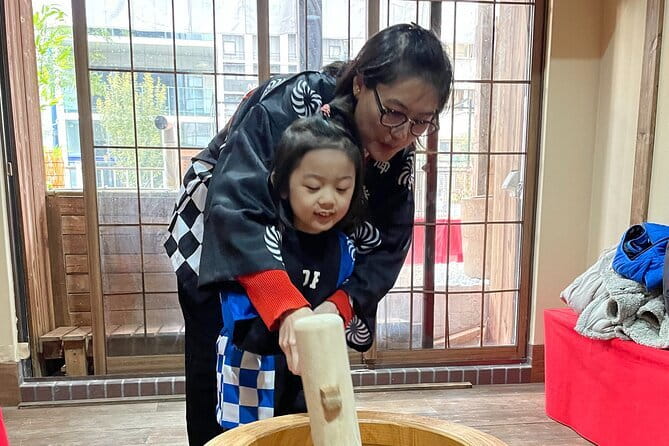
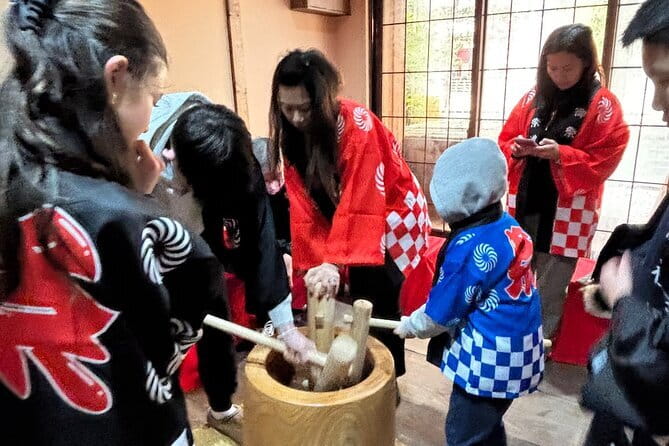
Next comes the rice. The session includes joining in the steaming process, followed by the main event: using traditional tools to pound the cooked rice into mochi. The physical work is the memorable part. You can participate directly, and the staff provide instruction so you know how to take part. One family described pounding in time with a spirited yo shoi chant, which gives you an idea of the lively group mood.
The activity is suitable for a range of ages, but it is still a hands-on process involving a heavy tool and sticky rice. Children can participate, with the instructors guiding the activity. If you are booking with young children, stay close and follow the staff’s directions around the pounding equipment.
Once the rice becomes mochi, it is time to eat. You can try it plain or with familiar Japanese accompaniments such as kinako, a roasted soybean powder; sweet red bean paste; nori, or seaweed; and sweet soy sauce. Tea is served alongside the tasting. The tasting is a useful part of the experience because it shows how the same soft, chewy base changes with sweet or savory flavors.
More trips and experiences around Osaka:
- Osaka Go Karting Tour with Funny Costume
★ 5.0 · 2,658 reviews - Osaka Castle: Museum and Tower Entry Ticket
★ 4.5 · 2,380 reviews - Osaka: Shinsekai Food Tour with 13-15 Dishes at 5 Eateries
★ 4.8 · 2,204 reviews
Why this works well for families
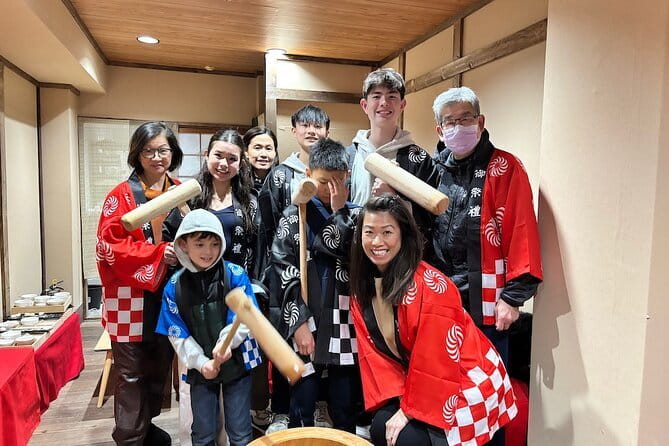
This is one of those activities where children do not have to sit quietly while adults listen. The introduction is brief, and the hands-on portion gives kids a clear role. Families with children as young as five and six have enjoyed taking part, while teenagers and grandparents have also joined in. The age range matters: this is not an activity that depends on being athletic or having prior knowledge of Japanese food.
It also gives families a shared task. You can take turns pounding, watch the rice change, and then taste the result together. The food provides an easy conversation starter for children who might be more interested in trying something they helped make than ordering an unfamiliar sweet from a shop.
The activity is open to adults without children, too. If you are traveling solo or with friends, you can still take part in the short cultural introduction, try the tools, and sample the finished mochi. The group limit of 10 helps keep the session from feeling like a large crowd pressing in around a demonstration.
A practical note for families: mochi is sticky and chewy. The activity advises elderly participants to eat rice cakes in small portions because they can pose a choking risk. That warning is worth taking seriously for anyone who has difficulty swallowing, regardless of age. Take small bites and do not rush the tasting.
What the toppings add to the tasting
The mochi itself is simple, which is exactly why the toppings matter. Kinako adds a toasted, nutty quality. Sweet red bean paste makes a more familiar dessert combination, while nori and sweet soy sauce take the tasting in a savory direction. Trying more than one option gives you a better sense of how versatile mochi can be.
The activity promises five beloved seasonings and ingredients, and the named options are a good guide to what you may encounter. Some participants have described having even more choices, but the dependable expectation is a selection of toppings rather than a fixed, guaranteed count beyond the details provided for the session.
You may also find the tasting is generous. The experience is built around eating the mochi you have helped make, and families have found there is plenty to share. That is part of the value: you are not paying only for a few bites of a sweet. You are paying for the instruction, the chance to use the tools, and the meal at the end.
A short cultural stop in Dotonbori
The meeting point is Mochi Pounding Experience Osaka, also called Oh Mochi, at 2-chōme-4-11 Dōtonbori, Chuo Ward. The activity ends back at the same place. Its location near public transportation makes it practical to add to a day in central Osaka, and Dotonbori itself gives you somewhere to continue exploring afterward.
The setting is useful, but the session is not a walking tour of the neighborhood. You should think of it as a compact indoor-style food activity at a fixed address, followed by the option to explore Dotonbori on your own. If your schedule is tight, the short duration makes it easier to place between meals, shopping, or other sightseeing.
The listed duration is about one hour. Some participants have completed the activity in roughly 45 minutes, so leave a little breathing room rather than planning around an exact minute-by-minute finish. The experience is capped at 10 people, a manageable size for receiving instruction and taking turns.
Instruction is provided in English and Chinese. Chinese support may be delivered through slides or interpreted with ChatGPT, so the exact format can vary. If language clarity is especially important to you, keep that in mind when deciding whether this activity suits your group.
Same city, a different kind of day:
- Osaka Food Tour: 13 Dishes at 5 Local Eateries
★ 5.0 · 2,149 reviews - Hungry Osaka Street Food Tour:15 Tastings & 3 Drinks with a Local
★ 5.0 · 1,727 reviews - Osaka: teamLab Botanical Garden Entry Ticket
★ 4.5 · 1,710 reviews - Osaka: Tea Ceremony Experience
★ 4.9 · 1,426 reviews
Is $32.29 good value?

At $32.29 per person, this costs more than buying mochi from a shop. The comparison is not quite fair, though. You are paying for a short lesson about the tradition, participation in the steaming and pounding process, use of traditional tools, a tasting with several accompaniments, and tea.
For a family, the value depends on whether your group likes doing things together. If everyone wants a hands-on activity and will enjoy tasting the results, the price buys a distinct memory in a convenient central location. If you are mainly looking for a cheap snack, you can spend less elsewhere and skip the lesson.
The one-hour format can also be a benefit. It is long enough to learn the basics and take part, but short enough not to consume half a day. The trade-off is that you should not expect a detailed cooking course or an extended exploration of Japanese food culture. This is a focused introduction with a satisfying, edible finish.
Who will enjoy it most
Book this if you like food experiences where you do more than watch. Mochi fans get to taste it fresh, while curious eaters can learn how a well-known Japanese sweet is made. You do not need previous experience with mochi or Japanese cooking.
Families are a natural fit, especially those with children who enjoy practical activities. The group can include small children, teenagers, adults, and grandparents, though everyone should be comfortable around the pounding process and with the chewy texture of mochi. The activity also says it can accommodate vegan and vegetarian preferences, making it a useful option for mixed-diet groups.
You may want to skip it if you need a long, technically detailed cooking class, or if you have limited interest in tasting rice cakes. The session’s main appeal is the blend of a short cultural explanation, group participation, and eating the result. Without that combination, the price may feel high for an hour.
Booking and practical details
Confirmation is provided at booking, and you receive a mobile ticket. The maximum group size is 10. Free cancellation is available up to 24 hours before the start time; cancellations made less than 24 hours in advance are not refunded, and changes within that window are not accepted. The activity requires good weather. If poor weather causes a cancellation, you can choose another date or receive a full refund.
Should you book the mochi pounding experience?

I would book this if you want a short, sociable Osaka activity with a real hands-on element. The best reason to go is the sequence: learn a little, pound the rice, then taste mochi with several toppings. That makes the tradition easier to remember than a quick explanation alone.
It is especially worthwhile for families who want an activity everyone can join, or for food-minded visitors looking for something beyond another restaurant meal. Just keep expectations in proportion. This is a compact introduction, not a deep course, and the mochi’s chewy texture is not for everyone. If that sounds like a fair trade for an hour of making and tasting in Dotonbori, it is a sensible addition to your Osaka plans.
FAQ
How long does the mochi pounding experience take?
It is listed as approximately one hour. Some sessions have taken about 45 minutes.
Can children under 13 participate?
Yes. Children under 13 are welcome, and adults can also join without children.
What will I do during the activity?
You will hear a 10-minute introduction to mochi pounding, join the rice-steaming process, pound the steamed rice with traditional tools, and taste the finished mochi with tea.
What toppings are offered with the mochi?
Named accompaniments include kinako, sweet red bean paste, nori, and sweet soy sauce. The activity also describes a selection of five ingredients and seasonings.
Where does the activity meet and end?
It meets at Mochi Pounding Experience Osaka, also called Oh Mochi, at 2-chōme-4-11 Dōtonbori, Chuo Ward, Osaka. It ends back at the meeting point.
Is the experience available in English and Chinese?
Yes. English and Chinese are listed. Chinese may be provided through slides or interpreted with ChatGPT.
Just added around Osaka
- Mount Koya from Osaka: Cultural Small Group Day Tour★ 5.0 · 3 reviews
- Matcha Tea Bowl Experience in Osaka★ 5.0 · 11 reviews
- Master Washoku: 5 Core Techniques for Authentic Cooking★ 4.7 · 7 reviews
- Manno: Osaka Premium Wagyu BBQ Experience Reservation★ 5.0 · 4 reviews
- Learning Shodo with a kimono and Trying Samurai Calligraphy★ 4.2 · 7 reviews
- Katsu Curry OR Bento Making Cooking Class & Local Shop Tour★ 4.9 · 11 reviews
- Himeji: Private Guide Tour of the Castle from Osaka or Kyoto★ 4.5 · 7 reviews
- Osaka and Nara Customized Private tour with English Driver★ 4.7 · 4 reviews
Osaka Tours, compared.



Shinsekai Food Tour with 13-15 Dishes at 5 Eateries
Read our review →
Osaka Food Tour: 13 Dishes at 5 Local Eateries
Read our review →
Hungry Osaka Street Food Tour:15 Tastings & 3 Drinks with a Local
Read our review →