
Reviewed · OSAKA TOURS
【For adult】Traditional Mochi Pounding Experience with Tasting
Freshly steamed rice changes under your hands in this one-hour Osaka class: you take turns pounding it with a traditional mallet, shape the warm mochi, then eat it with Japanese toppings. It is an unusually hands-on way to meet a familiar Japanese food.
I like two things in particular: you make the mochi rather than simply watch, and the small group, capped at 10, gives everyone a chance to join in. The short history talk also gives context to the pounding, while the tasting lets you compare toppings such as kinako and sweet red bean paste.
One consideration: mochi is filling, and rice cakes can be a choking hazard, especially for older people, who should eat small portions. The room may also feel warm in hot weather, so lightweight clothing is sensible.
At a glance
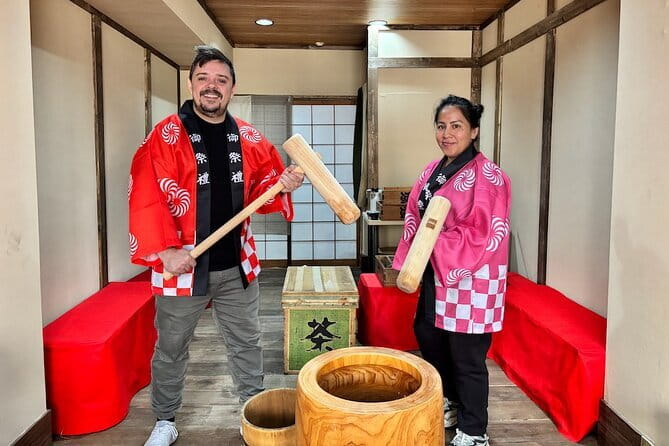
- Pound the rice yourself: Take turns working steamed glutinous rice with a traditional mortar and mallet.
- Learn the custom: A roughly 10-minute introduction covers mochi’s history and cultural significance.
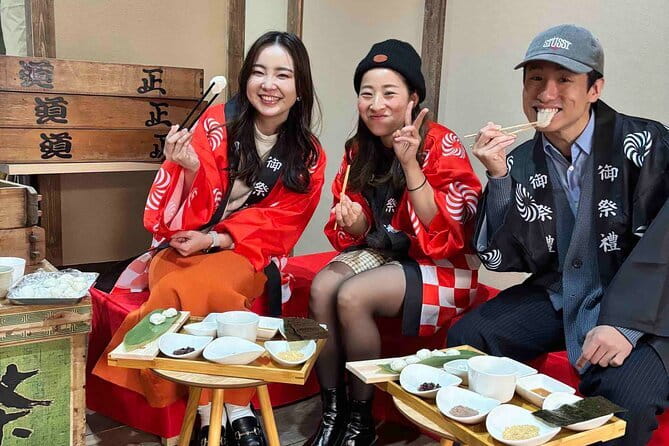
- Taste your handiwork: Fresh mochi comes with five advertised seasonings and ingredients, plus tea.
- Keep it small: Groups are limited to 10, and staff help make sure each person gets a turn.
- Plan around an hour: Morning and afternoon sessions make this a compact activity to fit into a day in Osaka.
Turning steamed rice into mochi
The session begins with a short talk, about 10 minutes, on the history and cultural meaning of mochi pounding. That context matters: the activity is not just a novelty with a wooden mallet. You get a quick introduction to a food tied to Japanese customs, then see how it is made from glutinous rice.
Next comes the steaming. You join the process of preparing the rice before it is pounded, which helps connect the finished sweet to its basic ingredient. The class is designed to cover the process from rice to mochi, rather than presenting a finished rice cake and asking you to admire it.
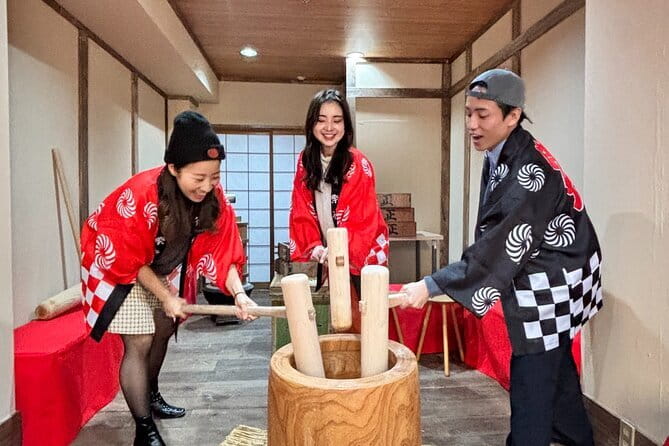
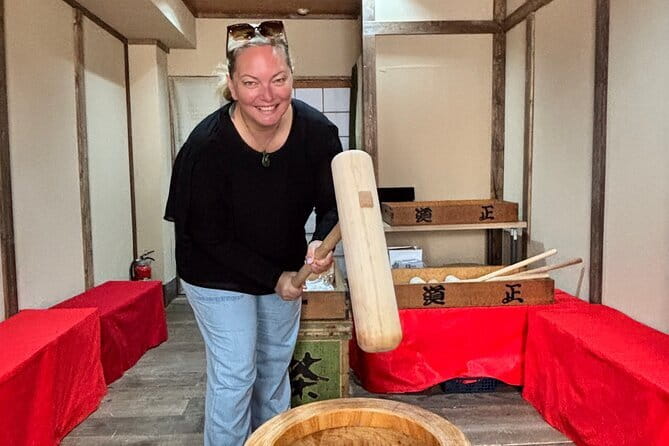
Then it is your turn at the mortar. Participants take turns striking and working the steamed rice with traditional tools, while the instructor guides the process. This is the most memorable part for many people: the transformation is visible, and you are doing more than taking a photo beside someone else’s demonstration.
The work is physical, though this is a short class rather than a fitness session. The staff keep the process moving and make sure people have a chance to take part. Children can use a smaller mallet, making the activity more manageable for younger participants. If you have twins or siblings who like to take turns, the shared task can be a good fit.
After pounding, you help shape the mochi in your palms. It is a simple step, but it gives you a better sense of the soft, warm texture before you taste it. Staff portion the mochi for the group, so you can focus on shaping and sampling rather than trying to serve everyone yourself.
More food and drink stops around Osaka:
- Osaka: Shinsekai Food Tour with 13-15 Dishes at 5 Eateries
★ 4.8 · 2,204 reviews - Osaka Food Tour: 13 Dishes at 5 Local Eateries
★ 5.0 · 2,149 reviews - Hungry Osaka Street Food Tour:15 Tastings & 3 Drinks with a Local
★ 5.0 · 1,727 reviews
A short cultural lesson, not a long lecture
The introductory talk is brief by design. In roughly 10 minutes, you hear about mochi’s history and its place in Japanese culture, then move into the practical work. If you want a detailed account of regional traditions or the full history of Japanese sweets, this class is not built for that.
For a one-hour activity, however, the balance makes sense. The background gives the pounding a purpose without taking up most of your visit. You leave with a little context and a practical memory: the feel of the rice changing as you work it.
The experience is offered in English and Chinese. Chinese information is provided through slides or interpretation using ChatGPT, so the format may be less conversational than the English instruction. If you need a particular language arrangement, it is worth checking before booking.
The instructors have included Aiko, Grace, Seina, Runa, Mao, and Riki. Names and staffing can change, but the activity is set up around guided participation, with staff helping explain the steps and keep the group involved.
Tasting mochi with different seasonings
The tasting is the payoff, and it is more than a token bite. You eat freshly pounded mochi with five advertised Japanese seasonings and ingredients, including familiar options such as kinako and sweet red bean paste, alongside a cup of tea. One participant described trying more than eight flavors, so the exact number or selection may differ from one session to another.
Fresh mochi has a soft, chewy texture that is quite different from a packaged version. The contrast is part of the point: you taste the result soon after making it, while the work of pounding is still fresh in your mind. If you usually know mochi only as a sweet dessert, the toppings give you a chance to compare flavors and decide which style you prefer.
The portions can be surprisingly filling. Plan your appetite accordingly if you have a big lunch or dinner booked soon afterward. You can sample the seasonings without treating the session as a full meal, but do not assume it is only a tiny tasting.
Mochi’s chewiness also calls for care. Older participants should eat small portions because rice cakes can pose a choking risk. This is sensible advice for anyone who has difficulty chewing or swallowing, too. The class is welcoming to families, but children should be supervised as they eat.
What the small group changes
With a maximum of 10 participants, this is a more personal activity than a large demonstration. The cap is useful because the central task involves taking turns with the mallet. In a much bigger group, you could spend more time watching than pounding; here, the format gives the staff a better chance to involve everyone.
It is also easy to take photos and videos during the activity. Staff have helped participants capture the process, which is handy when you are holding a mallet or shaping mochi and cannot manage a phone at the same time. Still, treat photos as a bonus, not the main event. You will get more from paying attention to how the rice changes and trying the tools yourself.
The session is promoted for families, and children are welcome. The smaller mallet gives younger participants a way to join in, while adults can take on the standard tool. If you are traveling with a mixed-age group, this shared activity offers a clear role for different ages without requiring prior knowledge of Japanese food.
Vegetarians and vegans are also welcome, and dietary preferences can be accommodated. If you have a specific restriction or allergy, contact the provider ahead of time rather than assuming every topping is suitable. The available information confirms accommodation for dietary preferences, but does not name every ingredient used.
More trips and experiences around Osaka:
- Osaka Go Karting Tour with Funny Costume
★ 5.0 · 2,658 reviews - Osaka Castle: Museum and Tower Entry Ticket
★ 4.5 · 2,380 reviews - Osaka: teamLab Botanical Garden Entry Ticket
★ 4.5 · 1,710 reviews - Osaka: Tea Ceremony Experience
★ 4.9 · 1,426 reviews
The Dōtonbori setting and one-hour schedule
The meeting point is Mochi Pounding Experience Osaka, also called Oh Mochi, at 2-chōme-4-11 Dōtonbori, Chuo Ward, Osaka. The activity ends back at the same place, and the location is near public transportation. That makes it practical to fit between other plans in central Osaka without setting aside half a day.
The class lasts about an hour, with morning and afternoon sessions available. That short format is a real advantage if your schedule is tight, or if you want a hands-on cultural activity without committing to a long cooking course. Allow a little breathing room around the scheduled time so you are not rushing straight from another appointment.
The venue is in Dōtonbori, but the activity itself is focused on the mochi-making process, not a walking tour of the district. Do not book expecting a guided introduction to nearby sights. Instead, treat the class as a compact stop that adds a different kind of experience to a day of sightseeing.
The room can get warm when the weather is hot, according to one participant’s practical tip. Lightweight clothing is a sensible choice, especially in summer. You will be using your arms, so clothes that allow easy movement are more useful than anything delicate or restrictive.
Is $32.37 good value?
At $32.37 per person, the class costs more than buying a packet of mochi, of course. But the comparison misses what you are paying for: a guided introduction, a chance to use traditional tools, the making process, and a tasting of the fresh result with several accompaniments and tea.
The value is strongest if you want to participate rather than simply sample a sweet. You get a clear beginning-to-end activity in about an hour, and the 10-person limit helps keep the hands-on part central. For a family or a small group of friends, it can also turn a snack into a shared memory.
It is less compelling if you only want to eat mochi or already have a packed schedule. The activity is short, but it still takes time to reach the meeting point and attend a set session. If your main goal is an extensive culinary lesson, this is a brief cultural workshop, not a full cooking class.
The price is reasonable for a guided, interactive activity with food included, especially if you value trying something you are unlikely to do at home. You are paying for the process as much as the snack.
Who will get the most from it
I would put this on the list for mochi fans, curious eaters, and anyone looking for a cultural activity that gets you moving. It is a welcome change if you have already booked more familiar options such as a tea ceremony or sake tasting. The pounding is lively, the shaping is tactile, and the tasting gives the class a satisfying finish.
It also suits families, since children are welcome and a smaller mallet is available. The activity is not just a talk for adults while children wait; the process gives younger participants a direct role. Keep the choking warning in mind when tasting, particularly for older family members.
If you are vegan or vegetarian, the provider says dietary preferences can be accommodated. Check any particular needs before you go, especially if you need a clear ingredient list. And if English is important to you, the class is offered in English; Chinese support may use slides or ChatGPT interpretation.
This is not the best choice for someone who wants a quiet, passive hour. Pounding rice is the point, and the room may be warm in hot weather. You should also be comfortable eating chewy rice cakes, or take only a small portion.
Practical details before you book
The ticket is mobile, and confirmation is provided when you book. The maximum group size is 10. Morning and afternoon sessions are available, though you should check the specific time that fits your plans.
Free cancellation is available up to 24 hours before the start time. Cancellations made later than that are not refunded, and changes within 24 hours are not accepted. The experience requires good weather; if poor weather causes a cancellation, you are offered another date or a full refund.
Should you book the mochi class?
Book it if you want a short, hands-on Osaka experience that joins food with a little cultural context. The strongest reasons are simple: you get to pound and shape the mochi yourself, and you eat it fresh with several Japanese toppings afterward. The small group and one-hour length make it easy to fit into a busy day.
Skip it if you only want a quick dessert, need a long and detailed cooking lesson, or would rather avoid a warm, active room. If the idea of turning rice into a chewy sweet sounds fun, this is a worthwhile use of an hour in Dōtonbori.
FAQ
How long does the mochi-pounding experience last?
It lasts approximately one hour.
Where does the experience begin and end?
It begins and ends at Mochi Pounding Experience Osaka, also called Oh Mochi, at 2-chōme-4-11 Dōtonbori, Chuo Ward, Osaka.
How many people can join a session?
The group is limited to a maximum of 10 participants.
Is the activity offered in English?
Yes. English is offered. Chinese is provided through slides or interpretation using ChatGPT.
What will I do during the class?
You will hear a short introduction to mochi’s history, join the steaming process, pound the rice with traditional tools, shape the mochi, and taste it with seasonings and tea.
Are children welcome?
Yes. Families with children are welcome, and a small mallet is available for children to use.
What is the cancellation policy?
You can cancel up to 24 hours before the start time for a full refund. Cancellations or changes made less than 24 hours before the start time are not accepted. If poor weather causes the activity to be canceled, you are offered a different date or a full refund.
Just added around Osaka
- Mount Koya from Osaka: Cultural Small Group Day Tour★ 5.0 · 3 reviews
- Matcha Tea Bowl Experience in Osaka★ 5.0 · 11 reviews
- Master Washoku: 5 Core Techniques for Authentic Cooking★ 4.7 · 7 reviews
- Manno: Osaka Premium Wagyu BBQ Experience Reservation★ 5.0 · 4 reviews
- Learning Shodo with a kimono and Trying Samurai Calligraphy★ 4.2 · 7 reviews
- Katsu Curry OR Bento Making Cooking Class & Local Shop Tour★ 4.9 · 11 reviews
- Himeji: Private Guide Tour of the Castle from Osaka or Kyoto★ 4.5 · 7 reviews
- Osaka and Nara Customized Private tour with English Driver★ 4.7 · 4 reviews
Osaka Tours, compared.



Shinsekai Food Tour with 13-15 Dishes at 5 Eateries
Read our review →
Osaka Food Tour: 13 Dishes at 5 Local Eateries
Read our review →
Hungry Osaka Street Food Tour:15 Tastings & 3 Drinks with a Local
Read our review →

Browse the lists this tour appears in