
Reviewed · OSAKA CASTLE TOURS
Learning Zen of Japanese Calligraphy in kimono near Osaka Castle
The appeal here is the mix of hands-on calligraphy and traditional dress: you change into a kimono or similar outfit, then learn to write a Japanese character with a brush. It’s a short cultural class, not a sightseeing lecture, and you leave with a personal souvenir.
I like two details in particular: you choose a kanji character and learn its stroke order, and the teacher writes your name on a wooden tag using the characters you chose. The small-group limit of 10 also gives the instructor room to help with your brushwork.
One caution deserves attention. Some people have had trouble finding the venue or reaching the operator, so confirm the address and the activity’s current arrangements before setting out. The supplied address is in Joto Ward, and the class is about an hour.
- Dress before you write: Traditional attire, such as a kimono or hakama, is included.
- Choose a kanji: You’ll practice a character and learn its stroke order, with guidance on basic brush movements.
- Take home a personal keepsake: The teacher writes your name in kanji on a wooden tag, and you receive digital photos by email.
- Expect a small class: The maximum group size is 10, and children can take part.
- Allow time to find the entrance: The address has been difficult for some people to locate, so don’t leave arrival until the last minute.
A calligraphy class with a personal keepsake
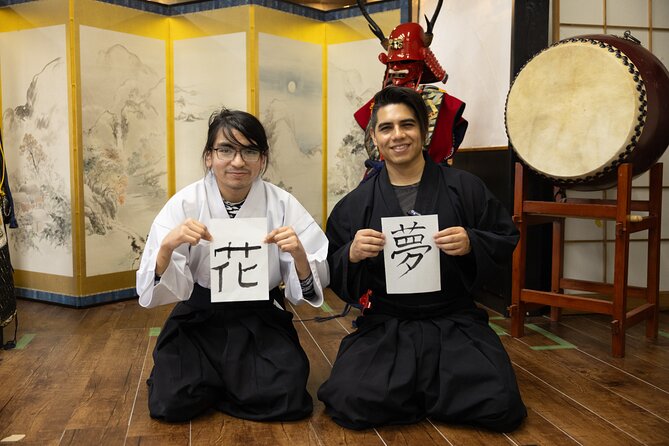
At $43.59 per person, this roughly one-hour session combines three things that can be hard to arrange on your own: a traditional outfit, an introduction to shodo, and photos of you with your finished work. You’re not paying for a long course or expert-level instruction. You’re paying for a compact, guided introduction that turns a few basic brush strokes into a personal memento.
The class is designed for beginners. You don’t need to read Japanese or have any calligraphy experience. The default teaching language is English, and an English-Japanese or Chinese-Japanese translator may assist. Other language support, including Italian, Spanish, French, Thai, and Indonesian, can be requested, but staffing is limited, so don’t count on a non-English option without confirmation.
That beginner-friendly approach is the point. A teacher demonstrates how to hold the brush, how to use the tools, and how to control the line. You practice, receive help, then try to make a final version. It’s a modest taste of shodo, not a promise that you’ll master it in an hour.
Getting dressed before picking up the brush
The session begins with changing into traditional clothing. The included outfit may be a kimono, hakama, or another traditional garment. Getting dressed adds a memorable visual element to the class, and it makes the photos feel more connected to the activity than a quick souvenir snapshot in your everyday clothes.
Plan to use the restroom before changing. The host specifically asks you to do so, and it’s sensible advice when you’ll be wearing layered clothing. The information provided also warns that participants can sweat easily in some outfits, especially during activities involving hakama or armor. For this calligraphy class, wear comfortable clothes beneath the traditional attire and avoid arriving overheated.
Hair styling with collected hair and a kanzashi ornament is an optional extra, priced at ¥3,300 per person. It is not part of the $43.59 base price. If the full traditional look matters to you, ask about this add-on ahead of time rather than assuming it comes with the outfit.
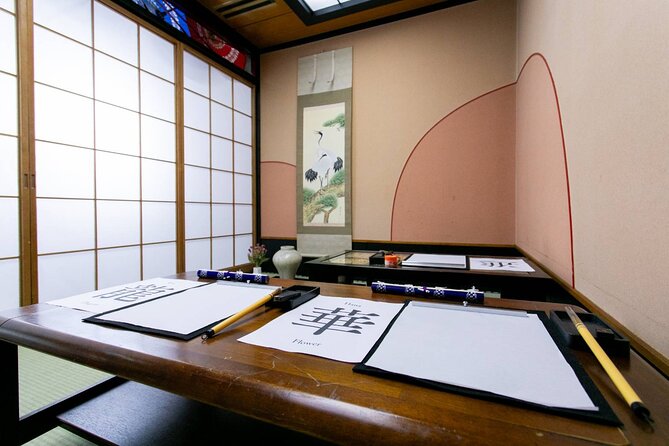
Some people describe sitting on tatami during the experience. That can be part of the traditional atmosphere, but the activity is not recommended for people with back problems or heart conditions. It is also not stroller accessible. Service animals are allowed, but pets are not.
More Osaka Castle tours around Osaka:
- Osaka Castle: Museum and Tower Entry Ticket
★ 4.5 · 2,380 reviews - Osaka Castle Walking Tour and Castle Tower Admission
★ 5.0 · 561 reviews - 5-Hour Osaka Bike Tour to the Neighborhood of Osaka Castle
★ 5.0 · 319 reviews
Understanding shodo through tools and movement
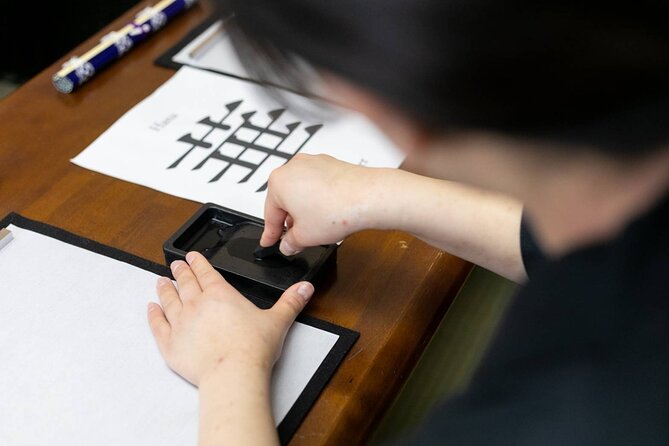
Once dressed, you get an introduction to the difference between Japanese shodo and decorative calligraphy found in other cultures. The class focuses on how the writing is made, not simply on producing an attractive character. Brush pressure, the direction of a stroke, and the way a line ends all matter.
You’ll learn to hold the brush and use the writing tools, then practice three basic movements: tome, the stopping stroke; hane, the hook or flick; and harai, the sweeping finish. These are small actions, but they help explain why a character is written in a particular way. The goal is to learn the movement behind the mark, not just copy a finished shape.
That distinction gives the class its strongest cultural value. Japanese kanji characters carry meanings, and their form is tied to stroke order and technique. You’ll get an introduction rather than a full lesson in the writing systems of Japanese. One participant felt the explanation of the different alphabets could have gone further, so if you want a broad overview of hiragana, katakana, and kanji, this is probably not the class to rely on for that.
The teacher’s patient, hands-on approach is a real advantage for first-timers. You can practice several times, get help as you go, and take the pressure off making a perfect first attempt. For children, that direct guidance is likely more useful than a long explanation of calligraphy history.
Choosing a kanji and learning its stroke order
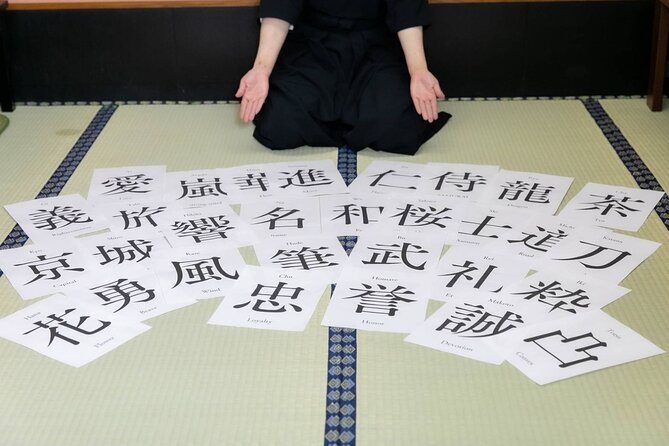
After the basics, you select a kanji character to work on. The character can be a word or idea that appeals to you, and the class gives you a chance to consider its meaning as well as its shape. Each character has its own associations, so choosing one is part of the experience rather than a decorative flourish.
The teacher then shows you the order and direction of the strokes. That matters because kanji is not simply a picture to trace. The sequence helps shape the character, and following it gives you a practical structure for your practice. You’ll try the character on practice paper before moving on to your final draft.
The pace appears to leave room for repeated attempts. The session is short, but the format is not just demonstration followed by a rushed photo. You practice with an instructor nearby, and the small group cap of 10 makes individual help more plausible than in a large workshop.
There is a limit to what an hour can do. Kanji is challenging, and this class will give you a feel for the process rather than fluency or a detailed lesson in Japanese writing. Think of the result as an introduction with a tangible souvenir, not a language lesson.
A wooden name tag, then your final piece
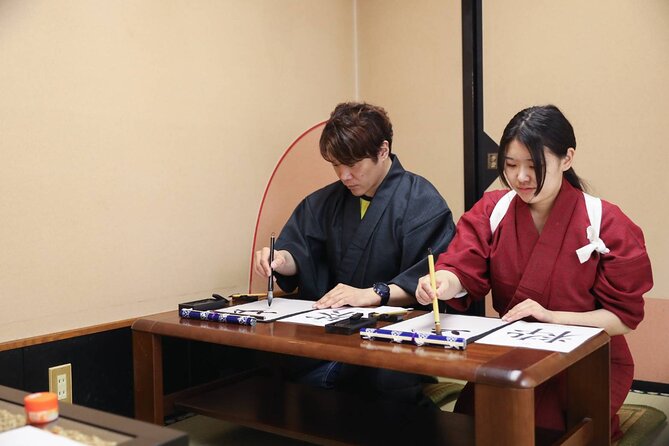
One of the more personal touches comes after you have chosen your character. The teacher writes your name in kanji on a wooden tag, using the characters you selected. It gives you a keepsake that connects your name to the lesson, and it’s a more thoughtful memento than a generic printed item.
Next comes your final draft. You apply what you’ve practiced and write the chosen character on your finished piece. Some participants have worked on fans and, in some cases, scrolls, with an additional fee for certain items. Since those materials and upgrades are not clearly guaranteed as part of the standard price, ask what your particular session includes before you book if you have your heart set on a fan or hanging scroll.
The final result is about the process as much as the object. Your brushwork may be uneven, especially if this is your first time holding a calligraphy brush. That is part of the fun. The point is to recognize the strokes you learned and see how your own hand put them together.
More kimono experiences around Osaka:
- Osaka: Sumo Show & Experience w/ Optional Kimono & Hot Pot
★ 4.5 · 609 reviews - Osaka: Kimono or Yukata Rental &Photos Service Options
★ 4.9 · 25 reviews - Kimono photoshoot-Includes 100 photo data
★ 5.0 · 21 reviews - Premium Kimono Dressing, Tea Ceremony, Calligraphy, Samurai show
★ 5.0 · 18 reviews
Photos in kimono, sent after class
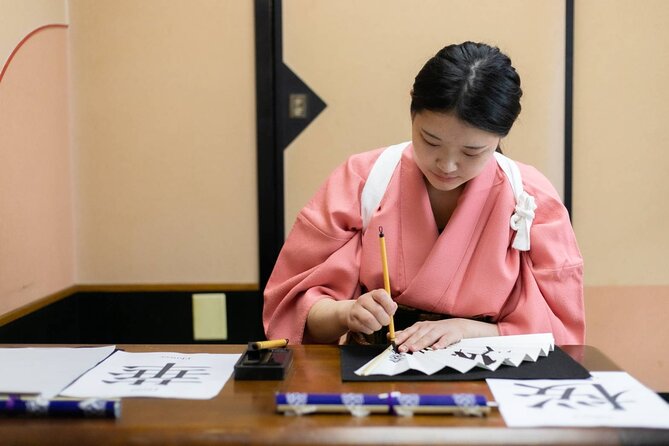
A photo session rounds out the class. The staff take pictures of you in traditional clothing with your calligraphy, and the digital files are sent to a designated email address. This is useful if you’d rather not juggle a phone while holding a brush or arranging your outfit.
You may also take photos with your smartphone, but the rules are specific: no selfies and no photographing other participants. Fixed tripods and video recording are not allowed, as they can disturb the group. If you want a picture of a particular moment, ask the staff to take it rather than setting up a camera.
The included photography adds value to the price, especially if you’re traveling with children or want a record of the outfit and finished work. Just remember that the photos are digital, not a printed portrait, and you’ll need to provide an email address to receive them.
Is $43.59 good value for an hour?
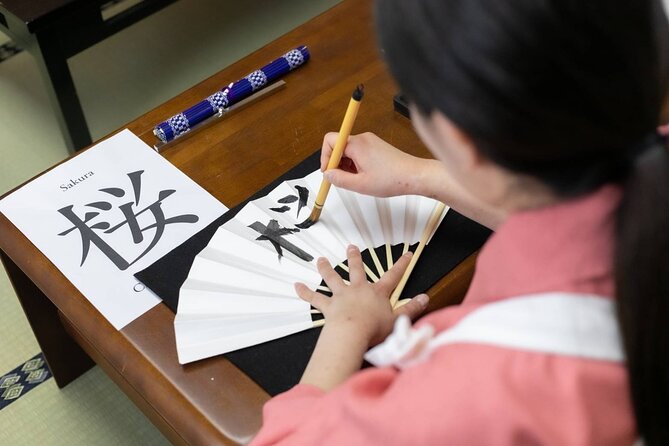
For a short class, $43.59 is not the cheapest way to spend an hour in Osaka. But the fee includes traditional attire, instruction, photography, and the teacher’s personalized wooden name tag. You’re getting more than a sheet of practice paper, though less than an extended cultural workshop.
The value improves if you’re curious about Japanese calligraphy but don’t want to commit to a longer course. It can also fit neatly into a day that includes Osaka Castle, since the class is promoted as being near the castle area. Keep in mind that transport to the venue is not included, and the meeting point is the activity’s address, not a hotel pickup.
A longer session may be possible in practice. One person described a 1.5-hour class, while the listed duration is approximately one hour. Treat the hour as the expected booking length and leave a little flexibility in your schedule rather than planning a tight connection immediately afterward.
The activity is often booked about 36 days ahead, so it may be worth arranging early if your dates are fixed. Free cancellation is available up to 24 hours before the start time. Changes or cancellations inside that 24-hour window are not accepted for a refund.
Finding the meeting point and avoiding a wasted trip
The biggest practical concern is the venue. The meeting address provided is Japan, 536-0014 Osaka, Joto Ward, Shiginonishi, 2-chōme 3-19, Excellence Takayama. Some people have found the location hard to spot, and others have reported arriving at an address where they could not find the activity or reach the host.
A positive account describes the location as a small storefront that was easy to walk past, even with accurate map directions. That makes it wise to allow extra time and check the exact entrance before your class. The activity provider has also acknowledged a temporary closure from June 9 to 29, 2025, and said its operating arrangements changed afterward. Because that information describes a past disruption, it does not establish the venue’s current status.
Before you leave, confirm the activity is running on your date, verify the meeting point, and make sure you have a working way to contact the operator. Do not assume the address is obvious from the street. The tour has a strict late-arrival warning: if you are more than 30 minutes late, you may be refused entry, even if you have sent a message.
The class ends back at the meeting point. Private transportation and station or hotel transfers are not included, so plan your own route. The activity is near public transportation, but the information provided does not specify a particular station or walking time.
Who will enjoy this class most
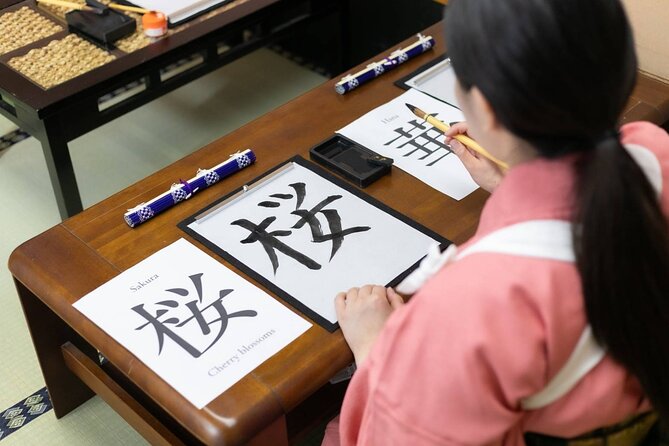
This is a good fit if you want a hands-on introduction to Japanese culture, enjoy making things, or would like a family activity that does not require prior skill. Children can participate, and the small group gives the teacher a chance to help with brush control. It also works well if you’re looking for an activity with a personal take-home item rather than another hour of sightseeing.
You may prefer a different experience if your main goal is a detailed history of Japanese scripts or serious calligraphy training. The class covers basic technique and a chosen kanji, but it is brief. People with back or heart conditions should also take the stated health cautions seriously, and families with strollers need to know the venue is not stroller accessible.
Should you book it?
Book this if you want a friendly, short introduction to shodo with the added fun of wearing a kimono and taking home a personalized keepsake. The strongest parts are the patient instruction, repeated practice, and the name tag written in kanji. At $43.59, those extras make the hour feel worthwhile for a curious beginner.
I would make one check before paying or setting out: confirm the current venue and that the class is operating on your date. The experience itself is appealing, but reports of missed contact and difficulty locating the address make that practical step important. If the operator confirms the details, this is a distinctive way to spend an hour near Osaka Castle.
FAQ
How long does the calligraphy class last?
The activity is approximately one hour. Some sessions may take longer, so leave extra time in your schedule.
What is included in the $43.59 price?
The price includes introductory calligraphy lessons, traditional attire, photography with digital files sent to an email address, taxes, and gratuities. Transportation and personal expenses are not included.
Do I need to know Japanese or have calligraphy experience?
No prior calligraphy skill is required, and the class is open to all skill levels. English is the default language, with an English-Japanese or Chinese-Japanese translator available to help.
What do I take home?
The teacher writes your name in kanji on a wooden tag, and you can take home your calligraphy work. Digital photos of you in traditional clothing with your work are sent by email.
Is the class suitable for children?
Yes. The class is open to children as well as adults, and beginners can take part.
Can I cancel for a refund?
You can cancel up to 24 hours before the start time for a full refund. Cancellations or changes made less than 24 hours before the activity are not accepted for a refund.
More craft workshops around Osaka
- Osaka: Private Japanese Calligraphy Experience
★ 5.0 · 66 reviews - Calligraphy Workshop in Namba, Dotonbori
★ 5.0 · 57 reviews - Osaka: Private Tea Ceremony and Calligraphy Experience
★ 5.0 · 50 reviews - Osaka Daruma Workshop — Paint Your Own Good-Luck Daruma
★ 4.9 · 46 reviews
Just added around Osaka
- Mount Koya from Osaka: Cultural Small Group Day Tour★ 5.0 · 3 reviews
- Matcha Tea Bowl Experience in Osaka★ 5.0 · 11 reviews
- Master Washoku: 5 Core Techniques for Authentic Cooking★ 4.7 · 7 reviews
- Manno: Osaka Premium Wagyu BBQ Experience Reservation★ 5.0 · 4 reviews
- Learning Shodo with a kimono and Trying Samurai Calligraphy★ 4.2 · 7 reviews
- Katsu Curry OR Bento Making Cooking Class & Local Shop Tour★ 4.9 · 11 reviews
- Himeji: Private Guide Tour of the Castle from Osaka or Kyoto★ 4.5 · 7 reviews
- Osaka and Nara Customized Private tour with English Driver★ 4.7 · 4 reviews
Osaka Castle Tours, compared.

Osaka Castle Walking Tour and Castle Tower Admission
Read our review →
5-Hour Osaka Bike Tour to the Neighborhood of Osaka Castle
Read our review →

PRIVATE 6hr, Food tour from Osaka Castle, Kuromon, Dotonbori.
Read our review →
A Tour to Explore the Symbol of Osaka: Osaka Castle
Read our review →
Browse the lists this tour appears in